

Introduction
the best way to think of an objective is, like a state function: it doesn’t matter how you get there, as long as you get there.
what I wanted to have was a comprehensive history of what I had read, as well as what I interacted intellectually with and liked over time. cataloging helps me upkeep my habit of reading—which i tend to get led astray from, if I don’t do it for a while—and consolidating information is the best way to ensure its retention. as for why did I choose to start a newsletter? the answer is as good as any—just because.
some of the stuff I read regularly, i.e. every day, is pretty basic. notably, it’s the Economic Times (print edition), Money Stuff, the daily Finshots issue, my X timeline, the first page of The Wall Street Journal (print edition), the home page of the Financial Times (website) and the FT Alphaville.
therefore, the issues will comprise of excerpts, data, and pieces from these more often that not. but, what else?
what will the newsletter feature? Likely, the following:
Op-ed pieces, essays, articles, and excerpts from various publications, newspapers, blogs, and books.
Art.
a historical anecdote featuring/from the life of a famous figure, alive or dead.
occasional update on my projects (about which I blog on my notion as well).
something I learnt/discovered on the internet or from the books I keep reading all the time.
what’s it going to be:
a summariser of all I have read and thought about.
sent out every month (?).
candid.
this candid angle is less natural to me than what one would expect. for most of my writing, I used to prefer well thought out sentences and a lot of editing & omission before deeming it capable of being read by anyone else but then, of course, I was introduced to Matt Levin’s money stuff and FT’s Alphaville.
I realised, verbosity is not evil.
The Pilot Issue
Tesla and Magical Thinking: Alphaville
the entire Tesla-Musk back and forth in regard to his compensation and incentivising him into taking tesla’s stock to mars with him seems like an obsessive-toxic ploy by a company (board) that is quite confused about its future and increasingly likely to fold to Musk’s terms (more ownership—he currently owns ~13% of Tesla).
Matt Levine’s commentary on “wounded lions”. [podcast]
When Eugene Fama introduced the Efficient Market Hypothesis in 1970, he argued that markets embody all available information and cannot be consistently outperformed. Ironically, the years around and after its publication were when hedge funds were posting some of their most spectacular gains.
here, Matt talks about the idea of second chances and how abundant they are if you are a portfolio manager and part of the hedge fund elite.
Alex Gerko and XTX Markets.
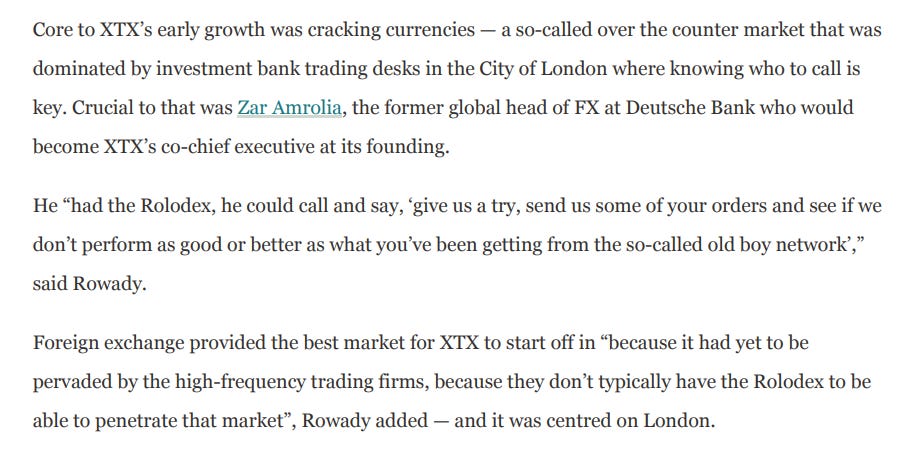
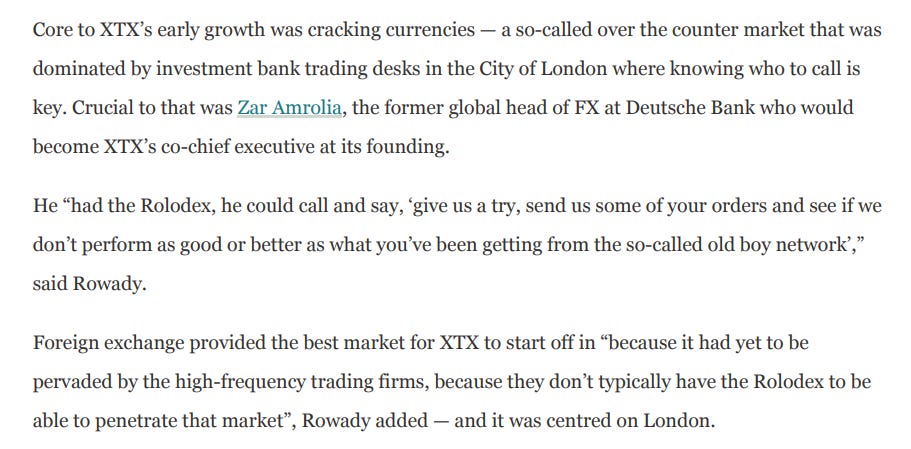
excerpt from the FT article—‘King of the geeks’: how Alex Gerko built a British trading titan often times in life, at least in the world of finance, knowing who to call and for what is a huge advantage. and if you’re on the other side of the call, with information following you—you’re likelier to have an outcome similar to Alex Gerko, and Michael Steinhardt (Chapter—“The Block Trader” in Sebastian Mallaby’s “More Money than God”) than otherwise.
Ruchir Sharma: The Fed, if it decides to cut rates, will be making a mistake
I also listened to a couple of podcasts on the Fed, its history and independence:
The turmoil around rate cuts—macroeconomic, geopolitical, even moral—is striking. For much of its past, the Fed served the sitting government, financing wars and policy priorities. Only after the 1951 Accord did independence and the question of central banking’s moral ground truly emerge.
The Fed’s almost saintly image, though, comes less from neutrality and more from its repeated rescues—bailouts, easing, soft landings. By stepping in time and again, it has risen to a stature above the president and the congress. But that trust is a burden: the more the Fed is seen as saviour, the harder it is to stay anchored to its real mandate(s)—price stability and maximum employment. which, too, were not its real mandate(s) for much of the first quarter of its existence (1914-1951).
Is Norway too rich for itself? + the guy managing the Norwegian sovereign wealth fund (Norges Bank Investment Management—they have a fairly active YouTube channel as well).
well, apparently, Norway’s government has been having the time of its life spending the returns from their sovereign wealth fund with less worry than any one of us could account for. although, this (irresponsible use of the funds) was brought up in the election debates quite fiercely by the opposition, the concern wasn’t grand enough to defenestrate the sitting government.
it’s an interesting turn of events. Norway has a lot of money, and they don’t know what the fuck to do with it. some numbers:
the government withdrew $54B from the fund this year (the entire fiscal budget was ~$200B). there were no spending cuts or raising taxes, instead they provided further aid to Ukraine. (looks like everyone’s following the Biden playbook—after all, the left is in power).
spending on sickness & disability is highest in the OECD group of rich countries (4x the average).
high-school dropout rates are above the European average.
the wealth tax has resulted in ~500 millionaires fleeing to Switzerlands in the last few years.
I mean, for all I know, this article was based on this book that got released in Norway recently, instead of an independent research/analysis by FT itself, so yeah, maybe its just propaganda. but, as biased as I am, I have never seen a left-leaning government being too proactive in preserving and progressing its country’s economy.
Armani’s Obituaries [The Guardian] [Reuters]
I tweeted on this actually.
Don Armani was a menace. but of the magnificent kind. he could just about do whatever he wanted—with his name, his empire, and his designs—yet, what he chose to do was persevere and preserve the elegance with which his work was first recognised back on Richard Gere, in 1980.
in an interesting turn of events, his will instructed his heirs to do exactly what he wouldn’t, “sell it all” (of course, not all at once. quite interesting).
Tesla Head Designer’s + His wife’s sustainable venture as their legacy
prior to joining Tesla in 2008, Franz von Holzhausen worked at Volkswagen and General Motors, apart from directing design of Mazda for a brief period between 2005-2008. he is, to Elon Musk, quite like what Jony Ive was to Steve Jobs.
his wife, Vicki von Holzhausen was an automotive designer. after that she’s, quite successfully, pivoted to designing products using sustainable materials (to great acclaim, as well).
The idea to read up on him came from seeing the design of the second-generation Roadster (beautiful). there’s a lot of debate around its delay (almost 8 years now, it was unveiled in November 2017), since it wasn’t a “concept car”.
one head, one crown.
Lachlan won it all over. The rest got $1.1B each and they’re ousted from the family trust.
the real story had a rather predictable ending, in contrast to the TV show—which was, well, heartbreaking (i am biased by the virtue of being the eldest boy).
AIF Cat-III: shortage of hedge funds in India
the shortage of Hedge funds in India is often pinned on the compliance and regulatory oversight over them. regular reporting and disclosure, the cap on leverage <= 2 x NAV, and tax on the fund itself.
it’s mayhem if you fancy being the big daddy here.
other reading included:
the rally gold is on and why. gold displacing the US Dollar as the reserve currency (the dollar still accounts for 58% of the reserves as per the latest data)—JP Morgan, as well, published something back in July on this.
Matt Levine wrote a sub-section on FABNs in his September 15 issue of Money Stuff which was incredible to read, since I was completely unaware of the instrument.
As for India, all is good. we’re getting up to speed as far as semiconductors are concerned, we’re 38th in the global innovation index, our exports grew YOY and imports reduced since tariffs were introduced by the Trump administration (looking at a reversal now). Nikhil, along with Tiger global and Qualcomm Ventures, invested in Nothing $200M series C. the IPO rally is going haywire (Urban company was subscribed >100x). Groww’s in the pipeline as well looking at a November listing. the NIFTY is back on the upward trajectory and gold hasn’t backed down at all. Vodafone Idea is still pleading for moratoriums. Hike decided to wind down operations, and Airtel’s on a lifetime run. I read up on Sunil Mittal as well, his HBS interview was good, as well as his wikipedia, which in itself contains a lot of information.
Poke, by Interaction, has taken X by a storm: a lot of the praise is directly correlated to the style of conversation (especially bargaining for the subscription fee—which is not fixed by the company). it can do pretty much all things that any other tool before it in the last 2 years has promised, under the offering as your “ai assistant”, but the differentiator for Poke is, funnily enough, it’s nowhere as polite or diplomatic or subservient as you would expect your ai assistant to be.
the craze for an AI product that behaves more like a human than a program/programmed intelligence reminds me of the title of a book zeko ai’s founder recommended me: Irrationally rational.